The default formula for StarForged Move checks is:
- Roll 1d6 (RISK) and 2d10 (CHALLENGE).
- Add the value of the appropriate Stat to RISK, as described below.
- CHALLENGE dice are not added together, but evaluated separately.
If RISK is greater than both CHALLENGE dice, it is a
STRONG YES
If RISK is greater than one CHALLENGE die BUT equal to or less than the other, it is a
WEAK YES
If RISK is equal to or less than both CHALLENGE dice, it is a
NO
Stats are much more important in SF than attribute scores are in D&D. In that system, you are rolling against a table of static values, modified only when your character has exceptionally high or exceptionally low attribute scores. And because those scores are generated on a bell curve, most scores cluster toward the center, where there are no modifiers.
In SF, the most appropriate Stat is always added to the Risk roll. This is critical for character survivability. The Stat is often given in a Move description, which is another reason Moves are important to the flow of play. This is the base description for the Move “Compel”:
When you try to persuade someone or make them an offer, envision your approach. If you…
- Charm, pacify, encourage, or barter: Roll +heart
- Threaten or incite: Roll +iron
- Lie or swindle: Roll +shadow
You can also make Stat checks without Moves. There is, for instance, no Carry Burden Move, so I’d just make a check against IRON.
Stats in SF are:
- EDGE
- HEART
- IRON
- SHADOW
- WITS
- HEALTH
- SPIRIT
- SUPPLY
Stats top out at 5, except in VERY unusual circumstances.
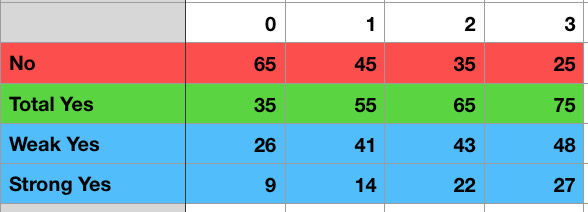
Here are the percentage results of 500 checks each, adding 0, 1, 2 and 3 to the Risk roll:
SF is regarded among contemporary players as quite lethal and unforgiving to characters. These folks haven’t played enough OG D&D, in my opinion.
As you can see, an unmodified RISK roll results in a range heavily weighted toward No.
But then, look at the massive shift when adding only 1. And the ratio of No to Yes completely inverts at 2, and ends up weighed toward Yes at 3.
On an unmodded roll, you can’t roll less than 1 or greater than 6, against a range of 1-10. But when you add +3, you can’t roll less than 4, and your highest is 9, drastically increasing your chances of at least a Weak Yes.
Unlike some RPG systems, SF considers a 1 to be an average Stat, so a 3 is exceptional, and a 5 is Jedi Ninja territory. But that’s kind of what I want in my heroes.
My character has a WITS of 4, and WITS is the Stat for Gather Information, hence the large number of Strong Yeses. That and a little luck.
Matches:
When the Challenge dice match each other, this generates a random event.
In SF, we roll a random Action and a random Theme, and we then interpret them to advance the story. On a Yes, the interpretation should favor the protag, and on a No, the opposite.
For instance, an Action roll of 72 and a Theme roll of 52 give us Raid and Law. This could be interpreted, perhaps, as a police raid that in some way either benefits or hinders the protag.