After sampling (way too) many rpg systems, solo and collective, and two in particular, I’m more or less done with the Beowulf Action Resolution Framework.
It ends up as yet another of the personal variants that are popular in some corners of the Old School Revival community. Not necessarily games in their own right, or even particularly original, they’re basically collections of slight modifications and “house rules”.
OSR is, again, a lineal descendant of our AD&D, with the basics being a collection of stats that define a character, and a combat system based on rolling d20 against a target number, whether that is called Armor Class, Difficulty Rating, or whatever.
Most, but by no means all, OSR systems use the original AD&D stat set: STR, DEX, CON, INT, WIS, CHA.Some of them shuffle them around a little, or change things like Charisma to Appearance, but that stuff’s basically just cosmetic.
Sometimes they’ll add a couple like Speed, Luck, or some such, or maybe take a few away, so you just have STR, DEX, CON and INT.
Whatever.We all know what’s going on.
But then you have those that really try to redefine stats:
Physique
Precision
Logic
Empathy
Swiftness
Spirit
Vigor
Resilience
Fortitude
Might
Guile
Swift
Wits
As you can see, these stats may or may not map back to SDCIWC, depending on how much you tilt your imagination.
Those last two are particularly interesting, as they come from games produced by the same team, and otherwise using the same game mechanics.TF?So if the samecreators alter things to suit the particular game…
Ah.Gotcha.I think.
Going back to early BARF R&D, then, we have a set of values that we “agree” define a character, and a system of game mechanics that can use those values to resolve a story.
Recently I came across an OSR variant that should have been self-evident to me a while ago.OSR usually resolves combat and skill checks with 1d20 vs AC or Difficulty.In this recent variant, if you want the Strong/Weak/Miss model, you roll 2d20 vs the target number, and then evaluate if those dice are over, under or equal to the target number.
(I also went back to the original AD&D text for a refresher.Based on the old to-hit tables, did you realize that a 1st level fighter only has about a 40% chance of hitting AC 10?And an 8th level fighter still has a 20% chance of missing AC 10?)
Anyway, I’ve decided to split my dev effort.I’m going to finish BARF up as an OSR-adjacent system.Then I want to pursue the Tarot-based system I was kicking around, as well as Mournwind Manor, which will probably be a journaling or resource-management game. I need to do a little actual scholarship in game theory, but that’ll come.
I’ll work up a draft of the new BARF rules and let you know.The only thing I want to highlight here is the stat collection I’ve settled on.In keeping with the “B” theme of the Beowulf Action Resolution Framework, those stats are:
Brains
Brawn
Balance
Body
Breath
Beyond
Feel free to map these to wherever you want.
BARF treats skills a little differently, and has a variant of a luck/karma pool I’ve seen and liked in other systems.But all of that will be in the rules.
The online TTRPG community is very open-source-oriented.Literally thousands of ppl regularly give away/share games, supplements, variants, etc.Eventually it might be a gas to throw BARF into the hat, butother than codifying my own house rules, that’s the only ambition I have for it.
As you know, I’m in love with this Strong/Weak/Miss dice pattern in rpgs. I first came across it in Ironsworn/Starforged, where it is cited as an implementation of a pattern that originated in one of the 1st-gen rpgs to break the D&D char model with any success, Apocalypse World. The system is now know as Powered by the Apocalypse, or pbta.
I’m sure I’ve gone over this before, but to refresh – in IS/SF, the actual mechanic is:
Roll 1d6 (Risk) and 2d10 (Challenge)
Apply any mods to Risk, usually 1 to 4
If Risk > BOTH Challenge = Strong Hit
If Risk > Challenge A && Risk <= Challenge B = Weak Hit
If Risk <= BOTH Challenge = Miss
It’s a little complex, but much faster than D&D and all the side-charts and whatnot.
When I finally got around to looking into pbta, I was surprised to find that in it’s original – and still current – version, it goes like this.
Roll 2d6 and sum
Apply mods
1-6 = Miss
7-9 = Weak Hit
10+ = Strong Hit
I initially looked at that and thought, well, of course they “upgraded” the system for IS/SF, bc the original is just too simple and can’t possible yield playable spreads…
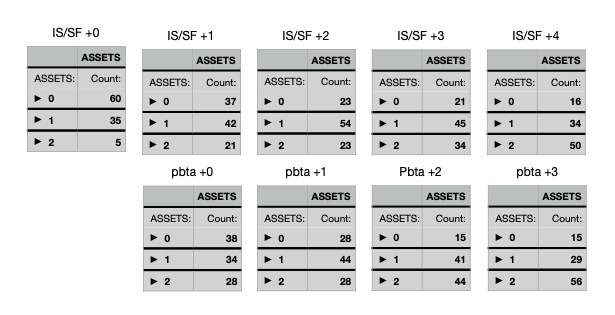
But the maths don’t lie! Bear in mind that in IS/SF, there is really no +0 – you are always rolling against a stat, so the progression really starts at +1.
When I line up IS/SF +1 with pbta +0, as you can see, the differences in the distributions are negligible in the context of play, particularly solo play, at least imo.
If you look just at the number of Misses, i.e. fails, they’re pretty consistent.
I think I was seduced by “complex = superior”, especially coming from such a polyhedral background. TBH, I’m not sure I’m comfortable with rolling just 2d6. WTF do I do with all my other dice???
OSR is Old School Renaissance, which encompasses modern RPGs that “hark back” to AD&D.
There are several descriptors for modern RPGs, since there are any number of core mechanics floating about, but most of them are more Story First in their overall orientation, thus my acronym for Story First Games.
Below is a general comparison:
Key Differences at a Glance
Feature
OSR Games
Modern RPGs
Philosophy
“Combat is a war”. Avoid fights unless necessary.
“Combat is a sport”. Balanced challenges meant to be won.
Gameplay Focus
Player creativity, exploration, and resource management.
Character progression, class abilities, and story arcs.
Rules Weight
Light and quick (few mechanics for out-of-combat actions).
Heavy and extensive (codified rules for almost every action).
Lethality
Brutal. Low-level characters die in one or two hits.
Heroic. Characters are rarely killed unless in a major boss fight.
Character Creation
Random and fast. You play whatever you roll.
Controlled and strategic. You design a build from level 1.
I don’t consider AD&D to be all that “light and quick”, considering all the tables involved, but that may just be because we had organically moved toward SFG anyway towards the end of my AD&D career.
Games like Starforged could also be called FFGs, or Fail Forward Games, as that is a core principle not explicated in the table above.
As the table says, characters are rarely killed outright. Even when rolls fail, the underlying philosophy is to advance the story in some way. Particularly in solo play, if your character dies, there’s no more story to tell.
The Protag: Mourn Blacklaw, called The Harrower. Typhon BloodStar was a little too flamboyant for a Solomon Kane-ish char.
Blacklaw comes, again, from my sci-fi/fantasy initiation in the late 60s. Magus Blacklaw is the hero of John Jake’s The Planet Wizard. In this case, Magus appears to be his actual first name, rather than a title.
My earliest SF/F heroes, even before I found REH, were John Carter of Mars, Adam Reith of Planet of Adventure, and Magus Blacklaw.
The Doggo: Skōl is the name of the great wolf who, in Norse mythology, will swallow the Sun at Ragnarok. Basically a “wolf in space”, so I think it’s appropriate.
Skōl is a neodog, a la Starship Troopers. As such, he has the following Assets in-game:
Intelligence: RAH makes an unfortunate comparison in the book regarding the relative intelligence of neodogs. In the Forge, neos are “chimp smart”.
Speech: As per Mr. H: They are capable of articulate speech, though their vocal cords cannot form certain consonants like ‘b’, ‘m’, ‘p’, or ‘v’. Humans simply have to “train their ear” to understand their unique accents. (Or provide them with some kind of speech synthesizer. CSN)
Psionic Tracking: Neodogs have the psionic ability to track sentient beings by their “mind-scent”. This is a form of psychometry – they read the traces of mind-scent left on the environment by the passage of a living being. They cannot, unfortunately, track any kind of undead revenant.
Scent Tracking: In breathable atmos, neos can also track by scent. They can track undead by physical scent.
Iron Vows:
From the rulebook:
For the people of the Forge, an iron vow is sacred. When you hold a piece of iron and declare your solemn promise to serve or aid someone, or to complete a personal quest, your honor is bound to that vow. Those who undertake these sworn quests are called Ironsworn. Abandoning or recanting an iron vow is the worst sort of failure.
Iron vows are the core of playing Starforged. It is your vows that drive you. These goals create the context for your adventures and challenges. As you complete vows, you gain experience and new abilities.
All quests are vows, but not all vows are quests. A vow to keep silent about something is a promise that is either kept or not – there isn’t an “end” to such a vow, in the sense that a quest ends with some attainment.
Momentum:
Momentum is a fairly complex mechanic in the game, but it boils down to this:
Characters accumulate Momentum by succeeding in various Moves. Momentum can then be “burned” to replace the Risk roll in a Move. However, Momentum must be burned in full, and not incrementally.
At the beginning of the next round of play, usually the next “scene”, Momentum “resets” to a specific value, usually +2.
Example:
A character has Wits2 and Momentum +6.
The character rolls a 2 for his Risk, a total of 4, and the Challenge dice are 7 and 9.
Normally, this would be a No, but the player can burn Momentum and replace the 2 with a 6, for a total of 8, resulting in a Weak Yes.
For the rest of this round/scene, the char has zero Momentum.
At the beginning of the next round, the char’s Momentum “resets” to the char’s Momentum Reset value, +2.
Oracle and Move Notation:
Going forward, Oracle rolls will include the odds (Certain, Nearly Certain, Likely, etc), the d100 threshold for those odds, the actual roll and the outcome, as in:
Oracle : <Odds> (<Odds%>) : <Roll> : <Outcome>
Oracle : Likely (60) : 31 : Yes
Move rolls will include the base Stat and value, any +/- modifiers and a brief explanation, and the outcome:
The default formula for StarForged Move checks is:
Roll 1d6 (RISK) and 2d10 (CHALLENGE).
Add the value of the appropriate Stat to RISK, as described below.
CHALLENGE dice are not added together, but evaluated separately.
If RISK is greater than both CHALLENGE dice, it is a
STRONG YES
If RISK is greater than one CHALLENGE die BUTequal to or less than the other, it is a
WEAK YES
If RISK is equal to or less than both CHALLENGE dice, it is a
NO
Stats are much more important in SF than attribute scores are in D&D. In that system, you are rolling against a table of static values, modified only when your character has exceptionally high or exceptionally low attribute scores. And because those scores are generated on a bell curve, most scores cluster toward the center, where there are no modifiers.
In SF, the most appropriate Stat is always added to the Risk roll. This is critical for character survivability. The Stat is often given in a Move description, which is another reason Moves are important to the flow of play. This is the base description for the Move“Compel”:
When you try to persuade someone or make them an offer, envision your approach. If you…
Charm, pacify, encourage, or barter: Roll +heart
Threaten or incite: Roll +iron
Lie or swindle: Roll +shadow
You can also make Stat checks without Moves. There is, for instance, no Carry BurdenMove, so I’d just make a check against IRON.
Stats in SF are:
EDGE
HEART
IRON
SHADOW
WITS
HEALTH
SPIRIT
SUPPLY
Stats top out at 5, except in VERY unusual circumstances.
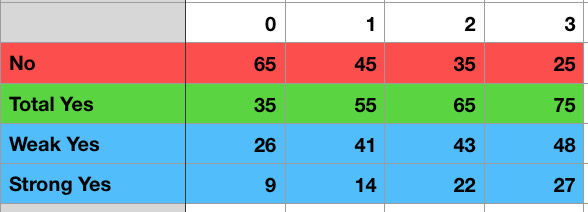
Here are the percentage results of 500 checks each, adding 0, 1, 2 and 3 to the Risk roll:
SF is regarded among contemporary players as quite lethal and unforgiving to characters. These folks haven’t played enough OG D&D, in my opinion.
As you can see, an unmodified RISK roll results in a range heavily weighted toward No.
But then, look at the massive shift when adding only 1. And the ratio of No to Yes completely inverts at 2, and ends up weighed toward Yes at 3.
On an unmodded roll, you can’t roll less than 1 or greater than 6, against a range of 1-10. But when you add +3, you can’t roll less than 4, and your highest is 9, drastically increasing your chances of at least a Weak Yes.
Unlike some RPG systems, SF considers a 1 to be an average Stat, so a 3 is exceptional, and a 5 is Jedi Ninja territory. But that’s kind of what I want in my heroes.
My character has a WITS of 4, and WITS is the Stat for Gather Information, hence the large number of Strong Yeses. That and a little luck.
Matches:
When the Challenge dice match each other, this generates a random event.
In SF, we roll a random Action and a random Theme, and we then interpret them to advance the story. On a Yes, the interpretation should favor the protag, and on a No, the opposite.
For instance, an Action roll of 72 and a Theme roll of 52 give us Raid and Law. This could be interpreted, perhaps, as a police raid that in some way either benefits or hinders the protag.
Is there enough time during this jump for TANS to finish processing the comm data and translate the Precursor symbols?
Oracle : Likely : Yes
What kind of luck has she had?
Gather Information : Wits4 : Strong Yes
She has restored the comm fragment from the rescue team. It is a horrifying cacophony of human shrieks and screams, punctuated by a final eerie moan that came from no human throat.
Can TANS identify that sound?
Oracle : 5050 : Extreme Yes
It is, she says, the sound characteristically made by undead balespawn when hunting.
It isn’t good news, but it also isn’t entirely unexpected. This is, after all, the Forge.
What of the Precursor ideograms?
Gather Information : Wits=4 : Strong Yes
It is a rendering of a ancient myth cycle, the basic elements of which are common to several Precursor races. It is a common form of decoration, and of no particular interest, except to academics and collectors.
Is it somehow related to Ayako’s desperate, unknowing sortie to the Shard, or is it simply a coincidence?
I ponder this, as I begin working on mods to Skōl’s suit.
Resupply (includes scavenging and fabrication) : Supply=5 : Strong yes
Kettir:
…
We drop out of jumpspace in the fringes of Kettir System.
(Your Humble Skald here – back in Pt1, the last thing we did was Set a Course, and we rolled a Strong Yes. Set a Course covers the entire span of a given journey, in this case the starjump, so the Strong Yes sees us safely through to the end of the jump.)
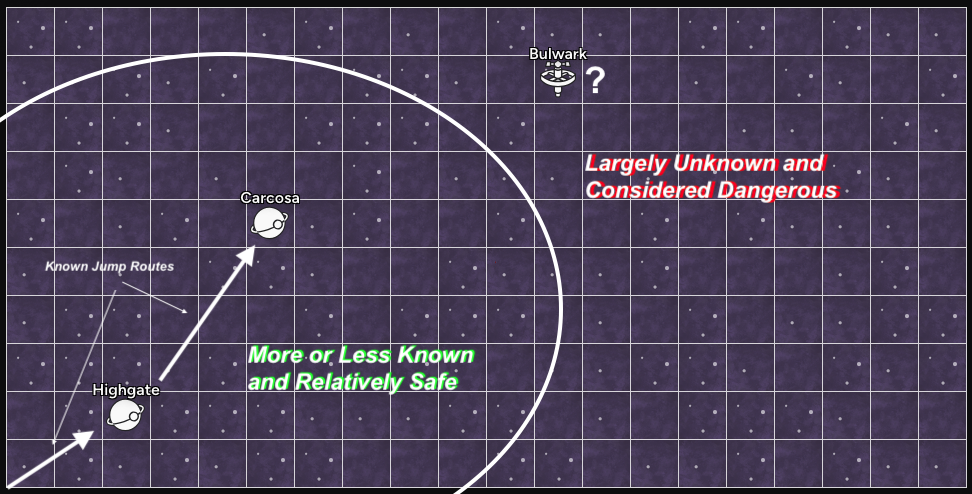
Kettir is a much busier system than Ardon. Because Highgate and Reverie Station aren’t major attractions, most spacers simply through-jump Ardon on the way to Kettir, using the mass-point of the former to boost them on to the latter. Most of the traffic in Kettir came via that through-jump, so it’s quite a bit more crowded. We would have through-jumped as well, had we not needed to meet Ayako at Reverie.
Kettir is also a rich system, and always wary, to one degree or another, of arrivals. It’s best not to tarry in the dropzone, so we began broadcasting out in-system ID, and TANS burned us into a fast orbit to Carcosa.
Do we encounter anything untoward during transit?
Oracle : Very Unlikely : No
Kettir is an orderly place, and we are soon negotiating for landing space at the Hali Spaceport.
Orbit:
…
(YHS: There is one disadvantage we will likely suffer if we fail Gather Information rolls during this scene: Attracting the attention of someone or something we would rather not. The odds are CERTAIN, when it comes time to ask the Oracle.)
Are we cleared to land quickly, or are we stuck in the queue for some time?
Oracle : Unlikely : No
(Oops. I unintentionally asked an OR question, which is not proper for a binary oracle. I’ll apply that No to the first part of the question, which then answers the second.)
We need the most current data we can get on the location and status of Bulwark.
We are not operating under the authority of any of the corporations that have interests on Bulwark, so pinging them might not be the best strategy, at least not this early in the investigation.
I have TANS submit a query to Traffic Control, appending my credentials as a Sentinel. While we have no official standing as such, we are notorious busybodies, so such a request is not, of itself, suspicious. Or so I hope…
(One definition of raid on M-W is: the recruiting of personnel … from competing organizations. Since this was a Strong Yes, I’ll interpret Raid Law as the SOS attempting to recruit me to supplement their investigation of events at Bulwark.)
We obtain the current data on Bulwark, and TANS begins to sift through it.
Meanwhile, we are pinged by System Orbital Security. They acknowledge and welcome my status as a Sentinel, and want to meet about possibly coordinating the investigation at Bulwark.
We have VIP docking at one of the SOS orbital facilities, and they have cleared and reserved landing space for us planetside.
Meeting
…
My goal in this meeting is to avoid any unnecessary entanglement with SOS and their agenda, while at the same time maintaining a fair and honest relationship.
(When I rolled up the stats for Hali, it came out with Initial Contact: Welcoming; Authority: Fair, so we can assume that Hali is known as a place where you may encounter bureaucracy, but not active hostility and corruption, and expect fair treatment in general.)
I figure there’s a 60% (Likely) chance that SOS is going to try to saddle me with a “companion”, ostensibly to help me figure out what’s going on at Bulwark, and represent them in that endeavor. They may just be trying to dissipate heat from local players with interests in Bulwark. It’s not something I’m particularly enthused about, and would rather avoid.
Oracle : Likely : 87=No!
The Oracle has spoken. SOS appears to have no agenda beyond solving the Bulwark mystery.
(My plan was to use the Compel Move to talk them out of sending someone with me, but the Oracle has rendered that moot.)
I do take the opportunity to enquire whether they have any additional data on Bulwark, over and above what was provided by Traffic Control.
(The chance of this could be low, in-game, so I’m going to roll an unmodified Gather Info check, just to be fair to the story.)
Gather Info : Unmodded : Weak Yes
(Ah, here we go. “On a weak hit, the information provides new insight, but also complicates your quest. Envision what you discover. Then, take +1 momentum.” So SOS drops some kind of bombshell, that’s going to stir things up. I need to consider this.)
Bombshell
…
I attempt to Make a Connection with the senior officer of the SOS party, one Bruno Valk, callsign Chimera.
Make a Connection : Heart=2 : Weak Hit
(On a strong hit, you create a connection. Give them a role and rank. Whenever your connection aids you on a move closely associated with their role, add +1 and take +1 momentum on a hit.
On a weak hit, as above, but this connection comes with a complication or cost. Envision what they reveal or demand.)
Bruno and I seem to be in the same orbit. After a few moments of silence, he nods. He has, he says, some additional information, highly secret, which he will share, provided I Swear an Iron Vow to remain silent about this intel. I, of course, agree.
Swear an Iron Vow : Heart=2+1(sworn to a Connection) : Weak Yes
(On a weak hit, you are determined but begin your quest with more questions than answers. Take +1 momentum, and envision what you do to find a path forward. Check out Vows and Momentum)
Bruno’s Intel:
A few days after Bulwark went dark, a small freighter, registered to that facility, was intercepted in the dropzone. The pilots were discovered to be undead balespawn. In addition, the freighter was carrying a shipping container with two dozen more undead inside.
These facts were determined later, because the pilots, upon interception, destroyed the ship. But enough debris and bodies were recovered for a thorough analysis.
An immediate search was initiated, and another container, delivered to the cargo area of Hali Starport only the day before, was found to contain a similar compliment of undead, in a dormant state of some sort.
What the purpose of these creatures might have been is speculative at best, but it was not one that would have benefited the people Hali and Carcosa.
This information is being heavily censored to avoid general panic.
I decide that, to understand what waits on the path ahead, I need to see what remains of the balespawn and their container.
Does Bruno approve and support this?
Oracle : Very Likely(70%) : 56 : Yes
With TANS docked, we leave in Bruno’s SOS skiff for the surface.
Interlude: TANSTAAFL
…
In Starforged, each character gets their very own starship, kind of in the manner of Han Solo, Boba Fett and others. You can’t be a spacefaring rogue without your own ship. There’s a table to determine how the ship came into the possession of the char, and the outcome I rolled was “Found abandoned in perfect condition.”
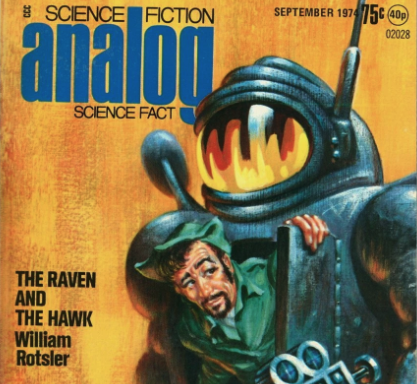
I decided to make TANS a Precursor ship, because that’s basically the plot of the excellent short story The Raven and the Hawk.
But I’ve written in a couple of governors:
She was in a form of stasis for literal eons, and her memory has degraded somewhat over the ages, despite the stasis. When it comes to knowing something specific about the Precursors, she has to pass a 50/50 Oracle check first, then make an unmoddedGather Information roll.
TANS was created as a kind of “star yacht”, rather than a warship. She was unarmed when Mourn found her, and her Eidolon drive, while superior to current human tech in some ways, is again somewhat limited by the inherent difficulty of star travel in the Forge.
Her amor and armaments are all “after market” human tech that has been modified to fit her. There are people and resources known to Sentinels that can be trusted with such weighty things.
As a fully functional, albeit somewhat amnesiac, Precursor vessel, she is a priceless artifact that some people would willing go to war to acquire. As such, we have to be extremely careful about revealing her abilities and true nature to others. This curtails the freedom with which we would sometimes like to use those abilities.
This last relates to the name Mourn gave her. If she had a name or other ID originally, she had forgotten it by the time Mourn woke her up. In considering the ramifications of such an unprecedented discovery, Mourn realized that possession of this one-of-a-kind ship might well be as much burden as blessing, and thus not the “free lunch” that it might initially appear.
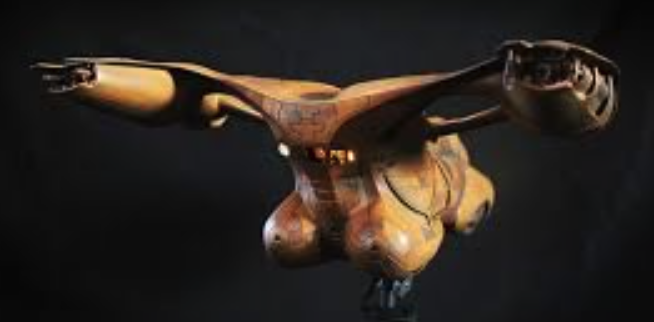
TANS’ personality is more or less modeled after Shad’s overly-buxom starship in Battle Beyond the Stars, but with a less irritating voice and a calmer, less girl-boss attitude.
(Really, Roger? Even for you…)
Externally, she is well camouflaged now, after years of trial, error and not a few near misses. Her appearance very seldom raises and eyebrow now.
Starport
…
Most system law enforcement organizations, orbital or planetside, employ canids of one sort or another. But neos are somewhat rare, especially in the Outlands. And I daresay, Skōl is familiar with scents, physical and mental, that in-system doggos have never experienced. So he goes with me.
Do we encounter anything untoward during our descent/landing at the starport?
Oracle : 11 = Random Event : 88, 62, 05
(When the digits of the Oracle roll are the same, a Random Event is generated. In this case, the prompts are Focus: 88=Territory, Action: 62=Locate, Theme: 05=Balance. I have no idea what this could mean in the current context, but it *may* refer to a “remote event”. Focus is basically scope, so Territory could indicate a sector-wide Focus. The rules provide for simultaneous “in the meantime” events in solo play.)
My scalp prickles at one point in our descent, but Bruno seems unbothered. I look to Skōl, to find him watching me, as if to ask:
“Are you getting a bad feeling about this?” I give him a jaunty wink.
The sensation quickly subsides, and I turn to watch the silhouette of Hali looming on the screens, as we enter the landing pattern for the starport.
Observed from space: Sky-breaching ruins (The Shard); perpetual overcast
Planetside feature: Looted sites, moldering bones
Planetside peril: Corrosive environment
Planetside opportunity: Abandoned tech and art
Notes: Highgate is a dead world, murdered by the beings that formally inhabited it. It appears that they somehow poisoned the planetary atmosphere in one titanic accident, transforming it into a toxic and corrosive nightmare virtually overnight. Little remains of them or their culture, but enough is still found by the brave and foolhardy to fuel a healthy black market on Reverie. (See The Shards.)
The industrial component of Reverie deals with the manufacture and testing of highly specialized filtration, detoxification and decontamination. The planet is used to field-test these devices.
Everyone knows Highgate is dead, as dead as it gets. And yet, both corporate personnel and “prospectors” still report things moving in the shadows of the ruins, half-seen in the miasmic whorls of acid fog.
Planetside opportunity: Fortuitous change in the weather or atmosphere
Settlement: Hali
Planetside opportunity: Ghostglass prospecting
Notes: As the first inhabitable world settled in the Hollows, Carcosa naturally became the de facto base for almost all E&E (Exploration and Exploitation) ventures in the sector. Hali is now a bustling city with corporate salarymen rubbing elbows with deep space prospectors, while both keep a weather eye out for trouble and profit.
But Carcosa has a unique resource, all its own. At some time in the distant past, it appears that balefires actually swept the surface of the planet, and where they touched the dune seas, the sand was fused into a strange substance the locals call ghostglass.
Ghostglass shines with a weird inner light, of a color that isn’t easy to name, or even look at for more than a few moments. It would be otherwise unremarkable, except that the glow increases when baleful energies and entities are near, even vibrating if the threat is great enough.
Those who must risk encounters with such things often have one or more fetishes of ghostglass, often mounting them like gemstones in iron jewelry.
Captial: Hali
Settlement location: Planetside
Population: Hundreds of thousands
Description: Bustling trade and industry
Aesthetics: Corporate enclave and frontier town
First look: Industrial architecture, high-tech construction
Initial contact: Welcoming
Authority: Fair
Projects: Trade, mining, salvage
World location: Carcosa
Notes: None at this time.
Deep Space:
Unanchored Facility: Bulwark
Settlement location: Deep Space
Population: Hundreds
Description: Utilitarian
Aesthetics: Worn and lived in
First look: Industrial architecture, intimidating defenses
Bulwark is a deep space mining and salvage facility in the Hollows Sector. Recently, the Soulbinders received a message that a crew mining a nearby asteroid had broken into some kind of cavity, perhaps a Precursor vault of some kind. But before communications were abruptly and inexplicably terminated, the crew said they “had let something out”.
A four-man rescue attempt also disappeared, this time without any final contact.
As the closest Sentinel to the Hollows, I’ve been asked to investigate, along with my doggo Skōl and our ship, TANSTAAFL.
System Arrival:
…
Our first stop is Reverie Station, orbiting the graveworld Highgate.
Our contact is Ayako Thorn, a reputed mad seeress who nevertheless has information that could be valuable to our mission.
I drop out of transit space at the edge of Highgate System. Do I encounter any surprises?
Oracle: No.
I burn an orbit in to Reverie Station. Do I arrive without incident?
Oracle: Yes.
I dock at the Station.
Reverie Station:
…
This is not my first time on Reverie, so I know the places to go and the questions to ask.
Am I able to get a lead on my contact?
Gather Information: Strong Yes.
The day before, Ayako appeared to have some kind of fit or seizure. Then, when she was thought to be recuperating in a med-bay, she commandeered a friend’s planetary skiff, and was last detected descending toward an immense set of Precursor ruins called The Shard.
A rescue/retrieval flight was sent down, and the skiff was located, but no sign of Ayako could be found. Highgate’s toxic and corrosive atmosphere prohibited a more extensive search. Ayako has been given up for dead, because her suit oxygen would have run out before further action could be taken.
This much I learn from the warren-runners on-station, but the exact coordinates where the skiff landed are Station Security data, and unknown to the average mook.
I approach Security, present my credentials as a Soulbinder, and request the coordinates.
Gather Information: Strong Yes.
Security turns over the coords, and also tells me, anecdotally, that in the med-bay after her seizure, and before she hijacked the skiff, Ayako was raving: about “Shadows! Shadows on the stars!”.
I return to TANS, and we prepare to go planetside.
Skōl:
…
Can I locate something that belonged to Ayako, so that Skōl can get her mind-scent?
(Skōl is a genetically hybridized canid with abilities similar to Ellison’s “skirmisher” dogs. Once attuned to a “mind-scent”, he can track even when wearing an environment suit.)
Gather Information: No.
Can Skōl attune to her by visiting her quarters?
Oracle No.
Ayako’s quarters are off-limits for now, and I don’t have the time to finesse a way in.
Can Skōl find and track a generic human mind-scent if we get close on the surface?
Oracle No.
Could be better, but we play the hand we’re dealt.
Suiting Up:
…
Do I have an environment suit that will withstand Highgate’s atmo?
Check Your Gear: Strong Yes.
I have one for Skōl, too, but its atmo tanks have to be charged first.
Check Your Gear: Weak Yes. Sacrifice Resources: -1 Supply.
We depart for the planet’s surface, and the ruins called The Shard.
Undertake an Expedition: Strong Yes.
We reach the surface, and land where Ayako’s skiff set down.
In the Shard
…
The Shard towers above us, an inconceivably immense structure; an artificial mountain composed of hundreds, perhaps thousands of intertwining spires or minarets. Its surface, what I can see of it through the toxic fog of the atmosphere, is honeycombed with chaotically shaped openings.
We make for the nearest of these, intending to enter, if we can, the Shard.
Explore Waypoint: Strong Yes.
Skōl’s eyes are as good as his nose, thanks again to the scientists who created his forebears. He spots signs of recent passage, and we head further into the Shard.
Set a Course: Weak Yes.
We find Ayako in a vast, cavernous room in the Shard, but she appears to be dead.
Rescue:
…
Skōl, however, says that, this close, he can now feel her living mind, although it is very weak.
Gather Information: Weak Yes.
He suggests she might have put herself into some kind of trance, or used some kind of medication, to slow her metabolism and preserve her air. But he has no idea how to bring her out of it, nor how much longer she can survive.
Did I think to bring along an extra bottle of air?
Check Your Gear: No, I did not.
Can Skōl return to TANS, and fetch one?
Oracle No.
He has no way to carry a tank while in his suit. Nor can he really help me to carry Akayo back to the TANS for the same reason.
(We will need to look at modding Skōl‘s suit so we don’t have these issues in the future.)
I will have to carry her back to the TANS before her time runs out.
Discovery:
…
Before we leave, do I see anything odd or notable in this chamber?
Gather Information: Strong Yes.
There appear to be faint markings on the back wall of the cul de sac, which are ever so slightly self-luminous.
Am I familiar with Precursor ideograms?
Gather Information: No.
(I need to study more.)
I make a recording of the symbols for later analysis.
Return:
…
Back on Reverie, Ayako is re-admitted to the infirmary, under watch, this time.
I am obliged to wait until she is recovered enough to converse. I use the time to top off my resources.
Resupply: Strong Yes. +2 Supply.
Evac:
…
Even in her suit, Ayako proves no great burden, despite the treacherous going on Highgate.
Iron (Strength) Check: Strong Yes.
TANS is waiting for us, and pops the hatch as soon as we arrive. In the airlock, I crack Ayako’s suit, and start administering to her properly.
Heal: Strong Yes.
After a tense few minutes, her vitals rise slowly to nominal levels.
I secure her in a seat, and we depart the surface for Reverie.
Finish an Expedition: Strong Yes.
We arrive safely back at Reverie.
A Lost Vision:
…
When she is able, I speak with Ayako.
Gather Information: No.
Unfortunately, she does not remember anything from the time of her seizure until she awoke in the med-bay. She can only conjecture that the “shadows” came from some kind of vision or projection.
In the physical realm, she has recordings, said to be intercepts of transmissions from both the ill fated mining crew and its would-be rescuers. She was not in possession of them for long before her event, so they have not yet been analyzed by anyone.
Off to Carcosa:
…
Is TANS able to analyze the comm data and glean any info?
Gather Information: Weak Yes.
TANS confirms the final transmission from the original crew, but the supposed transmission from the rescue craft is too corrupt to make any sense out of it.
Does TANS think that additional processing time might lead to a better outcome?
Oracle: Yes.
Does TANS recognize the Precurso ideograms in my recording?
Oracle: Yes.
TANS says the symbols are a kind of decorative mural, recounting stories that may or may not be true histories. She will begin compiling a translation of this one.
With that settled, and no further reason to remain on Reverie, we prepare to leave for our next destination, Hali, the capital city of the planet Carcosa.
You have just witnessed a stage production of The King in Yellow.
You know you must reach Carcosa or go mad and perish.
You notice a message, nearly illegible, scrawled amongst other graffiti:
LAST TRAIN TO CARCOSA: MIDNIGHT
You immediately set out for the Station.
But making your way across Nyxopolis becomes a nightmare, as the avatars and minions of Nyarlothotep attempt to hunt you down before you can board the Train.
What’s more, Nyarlothotep itself is manipulating reality in the City, so that it becomes a constantly shifting maze of impossibly moving buildings and roads.
It’s a distinct possibility you will die trying to reach the Station.
But if you aren’t onboard the Last Train to Carcosa, it will be a certainty.
Storms and tides of strange energies that surge back and forth across the Forge, appearing suddenly, sweeping across systems and worlds, disappearing again, leaving chaos in their wake.Certain pieces of Precursor tech seem to respond to their presence, but little else is known, except for the jeremiad of woes that they bring to the Forge.
Baleshine:
Idiomatic for the unusual abilities that some appear to gain from balefire exposure.
Balespawn:
Lifeforms warped and twisted by too much exposure to balefire. Spawn are vicious, horrifying mutants easily recognizable by their many asymmetries and deformities, easily distinguishable from the indigenous lifeforms they once were. They are normally hostile and aggressive, but can sometimes be intimidated or even frightened away by displays of force and/or “magic”.