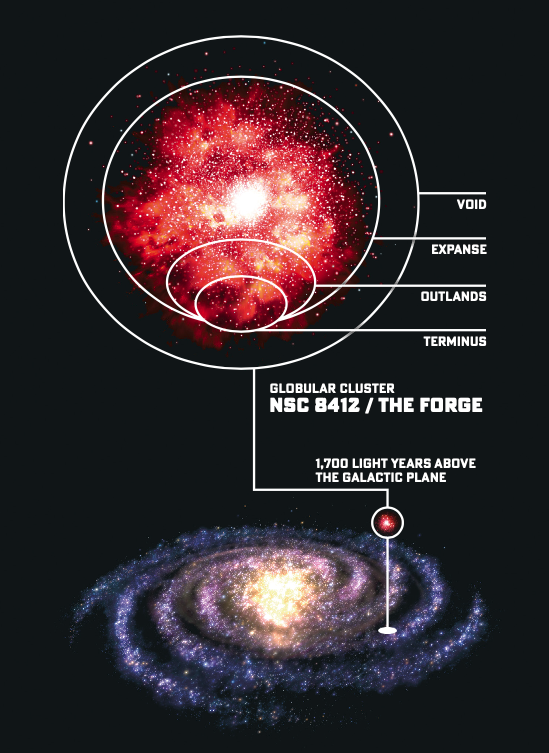
The Itani Gate is a Precursor artifact, but no one knows if it was created by one of the Precursor races from the Forge, or an unknown third.It provides instantaneous transit for spaceships from the Itani System in the galactic plane to the Forge some 1700 light years above.
The Gate is ancient – none know how old.It is generally reliable but not without its risks.The Gate has been known to “flicker” when in use, resulting in the destruction of the transiting ship.Others have simply disappeared into the Gate field – passing into one end, but never coming out the other, like a ghost train on Old Earth, vanishing into a tunnel beneath the hills.
When it became evident that the Forge was far from some bright new frontier, and that the most common reward for risking the Gate was a significantly abbreviate lifespan, interest in transiting waned.The Gate structure itself remained something of an enormous tourist attraction.But in the decades preceding the coming of the Otherlords, only the hardiest and most dedicated of scientists, prospectors and would-be tomb-raiders bothered to make the passage.
Early in the war, refugees used the Gate to flee to the Forge when they could.But for many, it was safer and easier to head further along the galactic plane, rather than risking a passage through the thick of the struggle.The bulk of the Exodus occurred in the years immediately following the war.
Itani Gate was always isolated, but since many populated systems near it were eradicated, it is even more so now, a circumstance that further reduces traffic through the Gate
The records tell us that the Otherlords broke into our reality, our space/time continuum, from somewhere else, from “Outside”.To those who saw them and lived, they appeared as moon-sized maelstroms of roiling energy and matter, and wherever they encountered life – or even the potential for life – they annihilated it.They scoured planets down to the bedrock, leaving only the bones and grave-dust of corrupt, contaminated worlds.
And yet, in crossing from their dimension into ours, the Otherlords in fact put themselves at a disadvantage.As immense and powerful as they were, they made themselves subject to the laws of our universe when they entered it.
Under the lash of imminent extinction, humanity created and deployed weapons of horrifying power and scope.Sun-lances that generated CMEs from a system primary star, then focused them like a laser.Singularity cannons that lobbed artificial black holes.And the worst – dark antimatter.
But these – and more – were used at a cost.Sun-lances left stars dangerously unstable; singularity cannons twisted the very fabric of space/time, and dark anti-matter weapons left a lingering taint, a contamination not unlike that of the Otherlords themselves.Fighting fire with fire, perhaps.
Bit by bit, the invaders were destroyed or pushed back to their origin point, an otherwise unremarkable mass point drifting in the void.If they expected to find a way out of our universe, back to their home, they were disappointed.Their doorway had closed.They were pummeled into memory.
Hundreds of years ago, humans fled a cataclysm in their home galaxy, and migrated to a globular cluster 1700 light years above the galactic plane.They called the cluster the Starforge, or simply the Forge.
Prompts and other bits lifted directly from the rules are in blue. My comments are in green.
Cataclysm:Inter-dimensional entities invaded our reality.Beings of chaotic energy.Titanic creatures of horrific power.
The human interstellar domain had just begun to flower when inter-dimensional entities invaded our reality.Not quite the Great Old Ones, but close enough.In the ensuing war to push these Otherlords back from whence they came, large swaths of settled space were devastated – not just laid waste, but tainted by the evil from Outside.
Exodus: Mysterious alien gates provided instantaneous one-way passage to the Forge.
Entire planetary populations – or what was left of them – had to be relocated in the aftermath of the war.Most pushed on past the existing borders of Known Space in search of untainted worlds to settle.But a handful of diverse groups decided that one Hell was as good as another, and elected to risk the Itani Gateand see for themselves just how inhospitable the Forge was.
Communities: We have made our mark in this galaxy, but the energy storms we call balefires threaten to undo that progress, leaving our communities isolated and vulnerable.
Legends now tell us that the Crossing was made by one huge fleet of refugees, but the reality is that there were successive waves over the next decade.Once word filtered back about the true nature of the Forge, passages trickled off.Now they are rare.Some in the galactic plane – “planers” – still seek the Forge hoping to find Atlantis or El Dorado.A few remain.Fewer still return.Most die.
Law:No prompt really fit.Based loosely on Traveler and the Dumarest chronicles.
The nature and weight of laws tend to reflect the local population density – where there are many people relatively close together, laws are stricter, more numerous and more enthusiastically enforced.Where the population is thin, not so much.Even in the same star system, there can be metropolitan centers that are safe and orderly, as well as outposts with a more frontier lifestyle.A general Covenant is more or less adhered to, particularly in the case of offworlders.Locals may wish they were that fortunate.
Religion: Our faith is as diverse as our people.
Many refugee waves that were religiously heterogenous soon “found religion” together in the Forge.It is a place that challenges one’s fundamental understanding of reality.Many have created semi-religions, centered aroundthe ritualization of practices that helped a particular group survive in the Forge.
Magic: Unnatural energies flow through the Forge. Magic and science are two sides of the same coin.
Soon after our arrival, some displayed the ability to harness the Forge’s energies. Today, those with “baleshine” invoke this power to manipulate matter or see beyond the veils of our own universe. But this can be a corrupting force, and the most powerful mystics are respected and feared in equal measure.
But it’s NOT “the Force” – it doesn’t depend on being infected with an embarrassing blood disorder.It appears to manifest in certain people who are exposed to balefire, but that is still speculation, albeit based on long observation.Abilities are generally modest, and often unreliable.Empathic reading, psychometry, life sense, limited prescience, limited telekinesis, limited healing and so on.Abilities are so random, unpredictable and haphazard that they have thus far defied all attempts to study or cultivate them in any organized fashion.One beneficial ability that is fortunately quite common among the affected is the ability to sense impending balestorms, which comes in quite handy when navigating and exploring deep space.
Communication and Data: Information is life. We rely on space-borne couriers to transport messages and data across the vast distances between settlements.
Direct communication and transmissions beyond the near-space of a ship or outpost are impossible. Digital archives are available at larger outposts, but the information is not always up-to-date or reliable. Therefore, the most important communications and discoveries are carried by couriers who swear vows to see that data safely to its destination.
Medicine: To help offset a scarcity of medical supplies and knowledge, the resourceful technicians we call riggers create basic organ and limb replacements.
Medical technology tends to follow the same curve as law – the more people, the better, on average, the medical tech and care.Advanced medical tech depends on advanced systems, and the Forge always plays Hell with those.Starships are shielded, and can even dodge the balefires, but space stations, planets and moons generally can’t.Medical transport is a lucrative business in the Forge.
This prompt seems to be written specifically to introduce “cyborgism” into the plot, a la any number of cyberpunk games.
AI: We no longer have access to advanced computer systems. The energies of the Forge corrupt advanced systems. Instead, we must rely on the seers we call Adepts.
Good luck with AI in the Forge.Even shielded spacecraft are not completely immune from these energy tides and storms, and often rely on evasion to survive them.Unfortunately, due to the physics involved, shields cannot be used to cover planets or planetary locations.And so far no thickness of native rock or combination of materials has proven completely resistant to balefires.Only the Precursor metal known as “black iron” is proof against them, and it is prohibitively rare and difficult to work.
Wars: No prompt fit. When war does break out, it has thus far been limited to on-planet and in-systems fracases.
Where there are humans, there will be conflict.But wars in the old sense, like the war against the Otherlords, are almost unknown.It’s difficult enough surviving in a stellar environment that is actively trying to kill you at every other moment.War is expensive and depletes all sides, leaving them less capable of enduring the Forge.
Lifeforms: This is a perilous and often inhospitable galaxy, but life finds a way.
For the most part, a planetary magnetic field will shield organic life from the worst effects of the balefires.For the most part.Life can be found everywhere in the Forge, even in the most hostile environments.But life on worlds subject to strong, chronic balefires can become warped and aberrant.Often Precursor ruins on these blasted worlds are occupied by such balespawn.
Precursors: Over eons, a vast number of civilizations rose and fell within the Forge. Today, the folk we call grubs—scavenger crews and audacious explorers—delve into the mysterious monuments and ruins of those ancient beings.
Two major non-human races occupied the Forge before humans.The first, known generically as the Elder, existed over 500 million years ago, and all that is left of them are the so-called vaults, a general term for the monolithic structures they left behind, some sealed, some empty and a rare few containing artifacts that can be studied.The second race came and went 50 million years ago, and are known as the Younger.They were able to reverse-engineer and mimic a certain level of Elder tech, and learned to use some that they could not replicate, but much remained unfathomable even to them.Some speculate that Younger meddling with Builder tech created the balefires.Because they never achieved the technological heights of the Elder, there are actually fewer Younger ruins remaining – their works simply didn’t endure as well as those of the Elder.
Players are encouraged to alter prompts to fit their vision of the milieu, so I’ve reduced “a vast number” to two. Maybe one more, but we’ll have to see.
Horrors: The strange energies of the Forge give unnatural life to the dead.
Balefires and Precursor tech can warp organic life.The worst of them can return the dead to a semblance of life.The phenomenon is not understood in the least, but it is real.The undead are real.
The inclusion of the undead was such an unexpected prompt that I had to include it. The weirder the better.
Factions:
Sentinels: A loose network of individuals who have dedicated themselves to making the Forge safe from baleful influences. While not centralized, they are a “guild” in the sense that their members are found everywhere, are generally held in high esteem, and are given great latitude by local authorities. Within their area of knowledge and action, they are a law unto themselves.
Type: Guild (Sentinels)
Influence: Notable
Projects: Keep the Forge safe from baleful influences
Relationships: A loose but vast network of talented and dedicated individuals
We see a lot of pastiches and homages to the various supporting characters in Dracula and their imagined descendants.1 Except for one: Quincy Morris.
Which is kind of odd, seeing as Quincy delivers one of the killing blows to the Count, the one to the heart, with his Bowie knife.
But wait – aren’t vampires immune to mundane weapons?
Well, yes, of course. But who says Quincy’s knife was mundane?
What if it was, in fact, the fabled knife of James Bowie himself, supposedly lost after the siege of the Alamo?
If it was, in fact, the legendary Iron Mistress, then it was made of literal star-stuff, meteoric iron that came from the fathomless depths of outer space. Or perhaps beyond.
What better to slay an otherworldly monster than an otherworldly weapon?
Sadly, Quincy dies from wounds sustained in the fight against the vampire, and nothing more is said, in the story, about the knife.
But we can speculate that, as was often customary in such circumstances, particularly for a minor hero, Quincy’s possessions were returned to his family in Texas. There, perhaps, the knife occupied an honored place on a wall of similar memories, and waited, down through the generations, before being sold off like so much clutter, in an estate sale.
Until some hapless nebbish buys it at a yard sale and (through events and circumstances yet to be written) finds that it is so much more than a mere priceless antique.
1 As far as we know from the text, Quincy had no children. However, in this context, “descendants” are considered to be anyone in his familial bloodline.
In The Black Castle (1952) Sir Ronald Burton, a British gentleman, investigates the disappearance of two of his friends at the Austrian estate of the sinister Count von Bruno, who is hunting unsuspecting English visitors a la The Most Dangerous Game, for past grievances against the British Empire.
Burton arranges to be one of Bruno’s “guests”, although Bruno knows nothing of his friendship with past victims.This all comes out in the denouement, when Burton reveals the truth to Bruno just before he kills him in revenge for his friends and countrymen.
In my twisted version, Burton is pursuing the two men he claims are “friends” to exact vengeance of his own.He tracks them to Bruno’s castle, and when he realizes Bruno has robbed him of his vengeance after so many years and so many hardships, he kills the nefarious Count.
In Loner, you create story momentum through a repeating loop of prompts:
Where are you?
What do you see?
Who else is there?
What’s going on?
What is your response?
Then you can – if you want to – generate random answers to all but the last which, one would hope, you want to decide for yourself.
Loner uses 2d6 in series, which generates values from 1-1 to 6-6, so 36 possibilities, which may seem low, but prompts usually don’t come in isolation, and you are often rolling on more than one table, to get values like “nervous smuggler” or “disgraced soldier”.IDK the math, but combining tables ups the total possibilities.
And it’s in these tables that you can customize the game to pretty much any milieu you want.A “Random Vehicle” table in sci-fi is going to be a lot diff from sword and sorcery.
This is a snapshot of the tables in Kwaidan.
ADVENTURE SEEDS
HAUNTED ARTIFACTS
MYSTICAL LOCATIONS
RANDOM EVENTS
SUPERNATURAL OMENS
CURSED VILLAGES
WANDERING SPIRITS
MYSTERIOUS VISITORS
RITUALS & CEREMONIES
FORBIDDEN KNOWLEDGE
SHAPESHIFTERS & ILLUSIONS
SEALED AWAY
SPIRITUAL BARGAINS
ECHOES OF THE PAST
GHOSTLY PROCESSIONS
SACRED RELICS.
YOKAI CONFLICTS
BLOOD TIES & FAMILY CURSES
NATURAL DISASTERS & OMENS
THE WORLD BETWEEN
INSPIRATION TABLES
Spacer doesn’t have an index of tables, but it has, for instance, tables for Stars, Planets, Moons and Asteroids and so on.Very different from Kwiadan’s tables.
(BTW, “Spells” appearing on the Spacer CS/char sheet appears to be a boo-boo, as that is the only hit on Spells I can find in the rules.)
You can also tweak the character structure a little.Kwaidan adds Chi, Honor and Corruption to the basic Loner character design.My (eventual) Norse adaptation will add Wyrd and Ond to the characters, the latter being kind of the Norse “mana”.
I wonder how much of this design concept came out of OOP.If you step back, it’s like the core rules are the interface, and the various genre modules are the implementations thereof.You can extend the class beyond the interface, but you have to conform to certain loose base requirements.
The number and nature of those tables is not a hard requirement – Kwaidan has many more tables than Spacer, but then esoteric Japanese folklore is not as speculative as sci-fi, there are certain real-world precedents.
Dirge is fun, and Kwaidan is just dripping, potentially, with atmosphere, but eventually I’m probably going to do a Norse-themed mod.
Many of the SRPGs I’ve reviewed over the past few weeks use Tarot cards as a random oracle, so I have perforce found myself handling the ol’ pasteboards again.Doing so has unlocked, or at least stirred, some very pleasant and poignant memories. Perhaps the approaching Hallows put me in a receptive frame of mind.
It only took a few moments of reflection to realize that, in focusing on my career and Shadow Work since 2014-15, I have unintentionally drifted away from contact and involvement with the Otherworlds and their denizens.
A so-called career path is a nearly universal distraction from the internal life, and more than enough has been said about that by others. Nonetheless, I found a great deal of satisfaction and validation in finally getting a “big boy” coding job, so it was “positive distraction”, perhaps?
For its part, Shadow Work is a wonderful modality, and I am eternally grateful for what I have learned from and through it.But in the end, it is based in archetypal psychology, and thus is not inherently mystical or spiritual, although the experience of Shadow Work can be both. I believe the majority of Shadow Worker would rejoice if it were suddenly to be declared “hard science”.
Zen also eschews the “woo-woo”, in favor of concentrating on taming the mind, and I’ve been easing deeper into Zen in the last 2 or 3 years.
All unknowing, in pursuit of one set of paths, I came to neglect another, which is at least as rich and valuable.
I’ve kept up my reading on the Norse, but again it’s been tending toward the academic and historical.I wave at the mythologies as they float past in context.
Perhaps, after a number of years immersed in the more phenomenological frameworks, I shifted base paradigms for a time, and just drifted.
But I’m back now, bitches.So hitch up yer drawers and hang onto yer broomsticks…
Phaseways are a trope I toyed with some years ago, inspired partly by the alien transporter tech in Assignment: Earth and partly by The Last Stand of the DNA Cowboys by Mick Farren.
Essentially, they began in my imagination as an immense web of “warp conduits”, but for individuals, not ships. The phaseways are Forerunner tech, so the current inhabitants of the galaxy use them, but don’t really understand them. With the proper tech or psionic ability, a person can “phase” from one destination to another, as easily as stepping through a door. (Which means the concept is also based on The Lion Game by James H. Schmitz.)
I intended it to be extravagant and unlikely, merely a gimmick that briefly infatuated me.
In the Dirge-iverse, I’m recasting the phaseways as the very aforementioned network of warp conduits, used by Affiliation ships to traverse the galaxy. I’m merging this with the concept of “forking” – the phaseways can be seen as an immense highway network, with “on- and off-ramps” forking off of larger, regional arteries.
“I’m forking off to Alpha Cent tomorrow…”
Even for the most advance Affiliation vessels, navigating the phaseways is a bit like riding a flatboat down a frontier river in the 1700s. There are obstacles and dangers that we are barely aware of and have little hope of understanding. Any Forerunner tech that makes forking safer and faster is highly sought by pretty much everyone – governments, cults, corporations, mad scientists and, of course, adventurers at large. (See what I did there?)
I’ve recreated Dirge’s Loner character card, and then expanded on each entry.
Name:
Dirge Darkrune
Concept:
Intergalactic Ne’er-Do-Well
Skills:
Crack Pistol Shot
Martial Arts Master *
Frailties:
Socially Clueless
Skua September
Motive(s):
Fame
Fortune
Goal(s):
Not Getting Caught
Getting Rid of Skua
Nemeses:
The Treemutes
Skua
Gear:
Ring Plaster
Intergalactic Ne’er-Do-Well
Dirge’s homeworld and intermittent base of operations is Bev-Arajh, a shabby, run-down former resort world fallen on hard times. In its heyday, Bev was the Jewel of the Cosmos, but now is more a cosmic roadside attraction with a reputation for tarnished glitz, grimy neon and shady street corner games of “chance’. (Think AC before the brush-up in the 80s.) Bev isn’t some kind of Casablanca, some exotic, neutral port of call. More like it’s just not worth the effort to anyone with the power to matter. Not that there’s a lot of crime and/or villainy that needs policing – cool and successful criminals do not come to Bev, and if they happen to be born there, they leave almost as soon as they become aware of that fact. It may be the generally bland, uninteresting and apathetic nature of the place that makes it an idea hideout for anyone who can withstand the crushing boredom.
Somewhat atypically, Dirge did not make the acquaintance of shady people and questionable places until he’d been off Bev for a few years, chasing the dream of government employment, and then only because he made the unfortunate acquaintance of Skua, as described below.
Crack Pistol Shot
Oddly enough, Dirge is an authentic crack shot, a Trinity-level savant with a handgun. Due mostly to the fact that there just isn’t a lot to do on Bev that doesn’t cost exorbitant amounts. A stolen, solar-powered pin-blaster (or plaster) – the Saturday Night Special of the day – can provide hours of diversion, practice and sometimes income. But the less said about that the better. They can even stun an opponent in a pinch. As non-lethal as you can get and still be mildly unpleasant, the proliferation of plasters on Bev led to a duelist culture among the youth and young adults. If you didn’t want to get plastered, you better be fast on the draw. And Dirge really disliked the post plaster hangover.*
Martial Arts Master
He is not, however, an authentic Master of the Martial Arts. Rather, he is yet another deluded punter who joined the notorious Black Dragon Fighting Society, founded in the distant past by the near-mythic Count Dante himself! Needless to say, Dirge would lose a lot more fistfights if it weren’t for Skua.
Socially Clueless
As a young, aspiring bureaucrat and politician, Dirge wasn’t all that socially awkward, more like trying too hard to be cool, and a little too narcissistic to read subtle social cues. He came to feel that he needed an edge to get ahead in the Skein, the vast tangle of governmental entities that somehow allowed the Affiliated Worlds to live and trade in relative peace. (“Affiliated Worlds”, because “Allied Worlds” was just a step too far.). Unfortunately, the solution that found him only made things worse. Social situations become intolerable when you might become a raging space pirate at any moment.
Skua
In his search for that edge, Dirge ran afoul of rogue tech. A pirate-themed personality analog chip that was supposed to help him be more daring and assertive ended up moving in beside his native consciousness and setting up business. Skua September, as it calls itself, usually manifests in those moments when Dirge’s normal clueless bravado falters, such as when he’s confronted with a beautiful woman or a dire threat. Then Skua emerges, and becomes the very incarnation of Blackbeard himself. But Skua is also highly erratic and unreliable. It can’t be depended on to pull Dirge out of a tight spot on-demand, as it were. Sometimes it just doesn’t give a fuck. It’s a construct, basically an autonomous trope, and doesn’t think like we do.
Fame and Fortune
Do a character’s motivations always have to complex or inscrutable? Financial security and social recognition have motivated humankind since its origins. Dirge grew up in poverty, and managed to turn a potential disaster into a career of sorts. Not the one he initially wanted, but certainly one that is way more exciting and profitable than driving a desk.
Not Getting Caught
As with the Stainless Steel Rat, it’s not just not getting caught, it’s avoiding capture with panache. Skua has a big Robin Hood complex, and Dirge sometimes finds it hard to keep money in the bank. While he lives comfortably, his alter ego’s profligate charity makes it necessary to seek income more often than he’d like.
Getting Rid of Skua
As implied above, living with a space pirate in your head can be a bit of a detriment to an early, comfortable and secure retirement. While Dirge has developed something like affection for the construct, the fact remains that, like early AI, it is not sentient, merely capable of mimicking sentience. Therefore, it cannot truly learn or grow, and so remains immature and virtually feral. It has, sadly, outlived its usefulness, and Dirge knows he needs to be shed of it.
The Treemutes
Treemutes are a species of genetically engineered lifeforms that resemble trees the way Jame Arness resembled a carrot in The Thing From Another World. They are somewhat more willowy than The Thing – see what I did there? – but no less lethal and grumpy. They appear like a somewhat smaller and leafier Groot, with long, highly flexible willow whips sprouting from their upper bodies and backs. While these thorn-studded whips are fast and dangerous, the creatures cover ground with all the speed of a gouty Tree Ent, and so are relatively easy to evade in close encounters. Dirge incurred their racial enmity during a particularly risky raid on Old Folks ruins.
They are the Daleks of Dirge’s story.
Skua
Honestly, there are times when the Captain is a greater threat to Dirge than the Treemutes.
Ring Plaster
One of Dirge’s somewhat unique pieces of gear is his ring plaster, a large, somewhat gaudy-looking ring that is in fact a kind of plaster derringer. Like most plasters, it can stun, and seems to recharge itself from any ambient electromagnetic source – sunlight, radio emissions, heat, etc. However, it is difficult to aim at any distance, and gives no indication of it’s current charge. Dirge has estimated that, at any given time, he has 7-12 shots. It is an artifact of Old Folks tech, and no one really knows how it works.
Notes
The Elder Peoples
The Elder Peoples – or, in the vernacular, the Old Folks or Codgers – are the highly advanced races that have populated the galaxy on and off over billions of years. There were several epochs or waves of Old Folks, and the galaxy is littered with their cast off late-night infomercial appliances. Most are simply more sophisticated versions of “Whippersnapper” or Younger Peoples’ tech, performing relatively mundane functions in weird and amazing ways, like quantum laser pruning shears or personal force-field umbrellas. Occasionally something actually worthwhile surfaces, like a sentient, telepathic universal healing module, or an ultra-miniature power source. Sometimes, people stumble on an Old Folks’ weapon. Whole solar systems have been know to wink out of existence shortly after the announcement of such a discovery. Much more common, but still rare to the average citizen, are body-weapons like ring plasters and thumb lances.
Thumb Lances
Thumb lances are a type of Old Folks device that might be a tool or weapon. In general, it is a featureless metal cylinder approximately 2-3cm in diameter and 10-12cm long. It responds to the thoughts of the holder, and will extend a needle or lance of indestructible metal using molecular nanoextrusion, the length of the lance conforming to the holder’s thoughts, but rarely exceeding two meters. Given enough force, the lance can theoretically pierce any substance known to the Younger Folks, but such requirements limit its use by average humanoids. The negligible weight of the “miracle metal” makes it nearly useless as a club, so the debate continues as to its original purpose. It could be a dueling weapon, a fruit skewer or a tool for spearing trash on the ground.
The term thumb lance refers to the impression of the lance springing from the thumb when held by a standard humanoid.
“Let me get this straight,” Lyman Orm said, with a perplexed smile.
“You’re first name,” he nodded in the direction of the thin, humorless-looking man with the Van Dyke, “Is Atticus?”
When that worthy nodded in confirmation, he turned to the stout, tough looking fellow to Atticus’ left. “And your last name is Finch?”
“Yessir,” Finch said, with a sour, “oh boy, here we go again” expression.
Atticus, who looked a bit as if he’d fallen out of a steampunk anime, cleared his throat, and stretched his lips in the wince that, for him, passed for a smile.
“I assure you,” Bane said in the voice of a professor ordering a bagel in the cafeteria. “Birdie and I…”
“Birdie?” Orm’s eyes widened with shear incredulity. “Birdie Finch? Oh, c’mon – who’s putting you two up to this?”
Now it was Finch’s turn to clear his throat. “I’m afraid so, sir,” he said, “My Christian name is Bertram, so it was rather inevitable, given the ways of small children and upperclassmen worldwide.”
His face the very definition of “gobsmacked”, Orm sat back, shaking his head in bemusement.
“I’ve already had breakfast,” he said. “But I suppose I can add one more impossible thing. So… What can I do for you gentlemen?”
Bane leaned forward with the air of an undertaker preparing to knot a client’s tie.
“It’s about a distant ancestor of yours, Dr. Orm…”