Categories
Forge of Legends

OSR vs SFG

OSR is Old School Renaissance, which encompasses modern RPGs that “hark back” to AD&D.

There are several descriptors for modern RPGs, since there are any number of core mechanics floating about, but most of them are more Story First in their overall orientation, thus my acronym for Story First Games.

Below is a general comparison:

Key Differences at a Glance

FeatureOSR GamesModern RPGs
Philosophy“Combat is a war”. Avoid fights unless necessary.“Combat is a sport”. Balanced challenges meant to be won.
Gameplay FocusPlayer creativity, exploration, and resource management.Character progression, class abilities, and story arcs.
Rules WeightLight and quick (few mechanics for out-of-combat actions).Heavy and extensive (codified rules for almost every action).
LethalityBrutal. Low-level characters die in one or two hits.Heroic. Characters are rarely killed unless in a major boss fight.
Character CreationRandom and fast. You play whatever you roll.Controlled and strategic. You design a build from level 1.

I don’t consider AD&D to be all that “light and quick”, considering all the tables involved, but that may just be because we had organically moved toward SFG anyway towards the end of my AD&D career.

Games like Starforged could also be called FFGs, or Fail Forward Games, as that is a core principle not explicated in the table above.

As the table says, characters are rarely killed outright. Even when rolls fail, the underlying philosophy is to advance the story in some way. Particularly in solo play, if your character dies, there’s no more story to tell.

Categories
Blacklaw Forge of Legends Shadows on the Stars

Production Notes

Renaming:

The Protag: Mourn Blacklaw, called The Harrower. Typhon BloodStar was a little too flamboyant for a Solomon Kane-ish char.

Blacklaw comes, again, from my sci-fi/fantasy initiation in the late 60s. Magus Blacklaw is the hero of John Jake’s The Planet Wizard. In this case, Magus appears to be his actual first name, rather than a title.

My earliest SF/F heroes, even before I found REH, were John Carter of Mars, Adam Reith of Planet of Adventure, and Magus Blacklaw.

The Doggo: Skōl is the name of the great wolf who, in Norse mythology, will swallow the Sun at Ragnarok. Basically a “wolf in space”, so I think it’s appropriate.

Skōl is a neodog, a la Starship Troopers. As such, he has the following Assets in-game:

  • Intelligence: RAH makes an unfortunate comparison in the book regarding the relative intelligence of neodogs. In the Forge, neos are “chimp smart”.
  • Speech: As per Mr. H: They are capable of articulate speech, though their vocal cords cannot form certain consonants like ‘b’, ‘m’, ‘p’, or ‘v’. Humans simply have to “train their ear” to understand their unique accents. (Or provide them with some kind of speech synthesizer. CSN)
  • Psionic Tracking: Neodogs have the psionic ability to track sentient beings by their “mind-scent”. This is a form of psychometry – they read the traces of mind-scent left on the environment by the passage of a living being. They cannot, unfortunately, track any kind of undead revenant.
  • Scent Tracking: In breathable atmos, neos can also track by scent. They can track undead by physical scent.

Iron Vows:

From the rulebook:

For the people of the Forge, an iron vow is sacred. When you hold a
piece of iron and declare your solemn promise to serve or aid someone, or to complete a personal quest, your honor is bound to that vow. Those who undertake these sworn quests are called Ironsworn. Abandoning or recanting an iron vow is the worst sort of failure.

Iron vows are the core of playing Starforged. It is your vows that drive you. These goals create the context for your adventures and challenges. As you complete vows, you gain experience and new abilities.

All quests are vows, but not all vows are quests. A vow to keep silent about something is a promise that is either kept or not – there isn’t an “end” to such a vow, in the sense that a quest ends with some attainment.

Momentum:

Momentum is a fairly complex mechanic in the game, but it boils down to this:

Characters accumulate Momentum by succeeding in various Moves. Momentum can then be “burned” to replace the Risk roll in a Move. However, Momentum must be burned in full, and not incrementally.

At the beginning of the next round of play, usually the next “scene”, Momentum “resets” to a specific value, usually +2.

Example:

A character has Wits2 and Momentum +6.

The character rolls a 2 for his Risk, a total of 4, and the Challenge dice are 7 and 9.

Normally, this would be a No, but the player can burn Momentum and replace the 2 with a 6, for a total of 8, resulting in a Weak Yes.

For the rest of this round/scene, the char has zero Momentum.

At the beginning of the next round, the char’s Momentum “resets” to the char’s Momentum Reset value, +2.

Oracle and Move Notation:

Going forward, Oracle rolls will include the odds (Certain, Nearly Certain, Likely, etc), the d100 threshold for those odds, the actual roll and the outcome, as in:

Oracle : <Odds> (<Odds%>) : <Roll> : <Outcome>

Oracle : Likely (60) : 31 : Yes

Move rolls will include the base Stat and value, any +/- modifiers and a brief explanation, and the outcome:

<Move Name> : <Stat>=<Value> +<Mod> (<Mod Note>) : <Outcome>

Swear an Iron Vow : Heart=2 +1 (sworn to a Connection) : Weak Yes
Categories
Forge of Legends

Rolling the Bones

The default formula for StarForged Move checks is:

  • Roll 1d6 (RISK) and 2d10 (CHALLENGE).
  • Add the value of the appropriate Stat to RISK, as described below.
  • CHALLENGE dice are not added together, but evaluated separately.

If RISK is greater than both CHALLENGE dice, it is a

STRONG YES

If RISK is greater than one CHALLENGE die BUT equal to or less than the other, it is a

WEAK YES

If RISK is equal to or less than both CHALLENGE dice, it is a

NO

Stats are much more important in SF than attribute scores are in D&D.  In that system, you are rolling against a table of static values, modified only when your character has exceptionally high or exceptionally low attribute scores.  And because those scores are generated on a bell curve, most scores cluster toward the center, where there are no modifiers.

In SF, the most appropriate Stat is always added to the Risk roll. This is critical for character survivability.  The Stat is often given in a Move description, which is another reason Moves are important to the flow of play.  This is the base description for the Move “Compel”:

When you try to persuade someone or make them an offer, envision your approach. If you…

  • Charm, pacify, encourage, or barter: Roll +heart
  • Threaten or incite: Roll +iron
  • Lie or swindle: Roll +shadow

You can also make Stat checks without Moves.  There is, for instance, no Carry Burden Move, so I’d just make a check against IRON.

Stats in SF are:

  • EDGE
  • HEART
  • IRON
  • SHADOW
  • WITS
  • HEALTH
  • SPIRIT
  • SUPPLY

Stats top out at 5, except in VERY unusual circumstances.

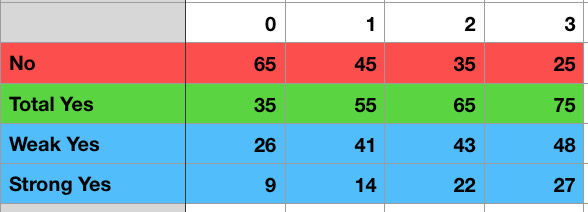
Here are the percentage results of 500 checks each, adding 0, 1, 2 and 3 to the Risk roll:

SF is regarded among contemporary players as quite lethal and unforgiving to characters.  These folks haven’t played enough OG D&D, in my opinion.

As you can see, an unmodified RISK roll results in a range heavily weighted toward No.

But then, look at the massive shift when adding only 1.  And the ratio of  No to Yes completely inverts at 2, and ends up weighed toward Yes at 3.

On an unmodded roll, you can’t roll less than 1 or greater than 6, against a range of 1-10. But when you add +3, you can’t roll less than 4, and your highest is 9, drastically increasing your chances of at least a Weak Yes.

Unlike some RPG systems, SF considers a 1 to be an average Stat, so a 3 is exceptional, and a 5 is Jedi Ninja territory.  But that’s kind of what I want in my heroes.

My character has a WITS of 4, and WITS is the Stat for Gather Information, hence the large number of Strong Yeses.  That and a little luck.

Matches:

When the Challenge dice match each other, this generates a random event.

In SF, we roll a random Action and a random Theme, and we then interpret them to advance the story. On a Yes, the interpretation should favor the protag, and on a No, the opposite.

For instance, an Action roll of 72 and a Theme roll of 52 give us Raid and Law. This could be interpreted, perhaps, as a police raid that in some way either benefits or hinders the protag.

Categories
Forge of Legends

Baleful Things


  • Balefires:
    • Storms and tides of strange energies that surge back and forth across the Forge, appearing suddenly, sweeping across systems and worlds, disappearing again, leaving chaos in their wake.  Certain pieces of Precursor tech seem to respond to their presence, but little else is known, except for the jeremiad of woes that they bring to the Forge.
  • Baleshine:
    • Idiomatic for the unusual abilities that some appear to gain from balefire exposure.
  • Balespawn:
    • Lifeforms warped and twisted by too much exposure to balefire.  Spawn are vicious, horrifying mutants easily recognizable by their many asymmetries and  deformities, easily distinguishable from the indigenous lifeforms they once were.  They are normally hostile and aggressive, but can sometimes be intimidated or even frightened away by displays of force and/or “magic”.
Categories
Forge of Legends

The Itani Gate


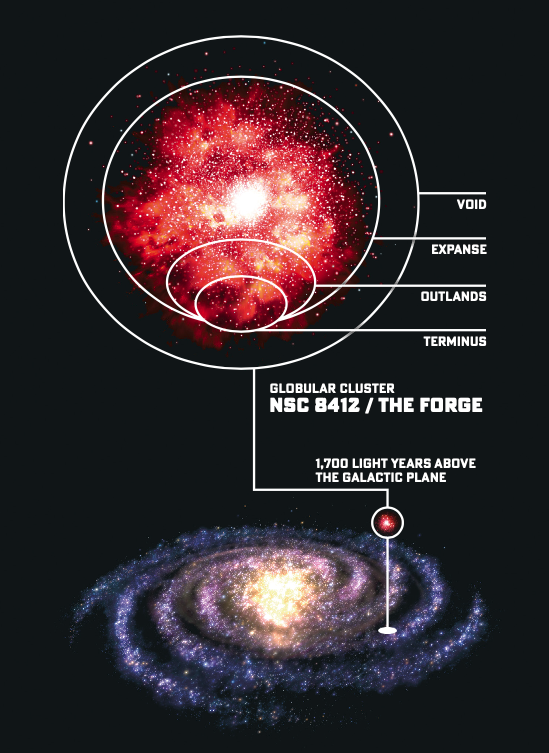
The Itani Gate is a Precursor artifact, but no one knows if it was created by one of the Precursor races from the Forge, or an unknown third.  It provides instantaneous transit for spaceships from the Itani System in the galactic plane to the Forge some 1700 light years above.

The Gate is ancient – none know how old.  It is generally reliable but not without its risks.  The Gate has been known to “flicker” when in use, resulting in the destruction of the transiting ship.  Others have simply disappeared into the Gate field – passing into one end, but never coming out the other, like a ghost train on Old Earth, vanishing into a tunnel beneath the hills.

When it became evident that the Forge was far from some bright new frontier, and that the most common reward for risking the Gate was a significantly abbreviate lifespan, interest in transiting waned.  The Gate structure itself remained something of an enormous tourist attraction.  But in the decades preceding the coming of the Otherlords, only the hardiest and most dedicated of scientists, prospectors and would-be tomb-raiders bothered to make the passage.

Early in the war, refugees used the Gate to flee to the Forge when they could.  But for many, it was safer and easier to head further along the galactic plane, rather than risking a passage through the thick of the struggle.  The bulk of the Exodus occurred in the years immediately following the war.

Itani Gate was always isolated, but since many populated systems near it were eradicated, it is even more so now, a circumstance that further reduces traffic through the Gate

Categories
Forge of Legends

The Otherlords


The records tell us that the Otherlords broke into our reality, our space/time continuum, from somewhere else, from “Outside”.  To those who saw them and lived, they appeared as moon-sized maelstroms of roiling energy and matter, and wherever they encountered life – or even the potential for life – they annihilated it.  They scoured planets down to the bedrock, leaving only the bones and grave-dust of corrupt, contaminated worlds.

And yet, in crossing from their dimension into ours, the Otherlords in fact put themselves at a disadvantage.  As immense and powerful as they were, they made themselves subject to the laws of our universe when they entered it. 

Under the lash of imminent extinction, humanity created and deployed weapons of horrifying power and scope.  Sun-lances that generated CMEs from a system primary star, then focused them like a laser.  Singularity cannons that lobbed artificial black holes.  And the worst – dark antimatter.

But these – and more – were used at a cost.  Sun-lances left stars dangerously unstable; singularity cannons twisted the very fabric of space/time, and dark anti-matter weapons left a lingering taint, a contamination not unlike that of the Otherlords themselves.  Fighting fire with fire, perhaps.

Bit by bit, the invaders were destroyed or pushed back to their origin point, an otherwise unremarkable mass point drifting in the void.  If they expected to find a way out of our universe, back to their home, they were disappointed.  Their doorway had closed.  They were pummeled into memory.

Categories
Forge of Legends

The Forge


Hundreds of years ago, humans fled a cataclysm in their home galaxy, and migrated to a globular cluster 1700 light years above the galactic plane.  They called the cluster the Starforge, or simply the Forge.

Prompts and other bits lifted directly from the rules are in blue.  My comments are in green.

  • Cataclysm: Inter-dimensional entities invaded our reality.  Beings of chaotic energy.  Titanic creatures of horrific power.
    • The human interstellar domain had just begun to flower when inter-dimensional entities invaded our reality.  Not quite the Great Old Ones, but close enough.  In the ensuing war to push these Otherlords back from whence they came, large swaths of settled space were devastated – not just laid waste, but tainted by the evil from Outside.
  • Exodus: Mysterious alien gates provided instantaneous one-way passage to the Forge.
    • Entire planetary populations – or what was left of them – had to be relocated in the aftermath of the war.  Most pushed on past the existing borders of Known Space in search of untainted worlds to settle.  But a handful of diverse groups decided that one Hell was as good as another, and elected to risk the Itani Gate and see for themselves just how inhospitable the Forge was.
  • Communities: We have made our mark in this galaxy, but the energy storms we call balefires threaten to undo that progress, leaving our communities isolated and vulnerable.
    • Legends now tell us that the Crossing was made by one huge fleet of refugees, but the reality is that there were successive waves over the next decade.  Once word filtered back about the true nature of the Forge, passages trickled off.  Now they are rare.  Some in the galactic plane – “planers” – still seek the Forge hoping to find Atlantis or El Dorado.  A few remain.  Fewer still return.  Most die.
  • Law: No prompt really fit.  Based loosely on Traveler and the Dumarest chronicles.
    • The nature and weight of laws tend to reflect the local population density – where there are many people relatively close together, laws are stricter, more numerous and more enthusiastically enforced.  Where the population is thin, not so much.  Even in the same star system, there can be metropolitan centers that are safe and orderly, as well as outposts with a more frontier lifestyle.  A general Covenant is more or less adhered to, particularly in the case of offworlders.  Locals may wish they were that fortunate.
  • Religion: Our faith is as diverse as our people.
    • Many refugee waves that were religiously heterogenous soon “found religion” together in the Forge.  It is a place that challenges one’s fundamental understanding of reality.  Many have created semi-religions, centered around  the ritualization of practices that helped a particular group survive in the Forge.
  • Magic: Unnatural energies flow through the Forge. Magic and science are two sides of the same coin.
    • Soon after our arrival, some displayed the ability to harness the Forge’s energies. Today, those with “baleshine” invoke this power to manipulate matter or see beyond the veils of our own universe. But this can be a corrupting force, and the most powerful mystics are respected and feared in equal measure.
      • But it’s NOT “the Force” – it doesn’t depend on being infected with an embarrassing blood disorder.  It appears to manifest in certain people who are exposed to balefire, but that is still speculation, albeit based on long observation.  Abilities are generally modest, and often unreliable.  Empathic reading, psychometry, life sense, limited prescience, limited telekinesis, limited healing and so on.  Abilities are so random, unpredictable and haphazard that they have thus far defied all attempts to study or cultivate them in any organized fashion.  One beneficial ability that is fortunately quite common among the affected is the ability to sense impending balestorms, which comes in quite handy when navigating and exploring deep space. 
  • Communication and Data: Information is life. We rely on space-borne couriers to transport messages and data across the vast distances between settlements.
    • Direct communication and transmissions beyond the near-space of a ship or outpost are impossible. Digital archives are available at larger outposts, but the information is not always up-to-date or reliable. Therefore, the most important communications and discoveries are carried by couriers who swear vows to see that data safely to its destination.
  • Medicine: To help offset a scarcity of medical supplies and knowledge, the resourceful technicians we call riggers create basic organ and limb replacements.
    • Medical technology tends to follow the same curve as law – the more people, the better, on average, the medical tech and care.  Advanced medical tech depends on advanced systems, and the Forge always plays Hell with those.  Starships are shielded, and can even dodge the balefires, but space stations, planets and moons generally can’t.  Medical transport is a lucrative business in the Forge.
      • This prompt seems to be written specifically to introduce “cyborgism” into the plot, a la any number of cyberpunk games.
  • AI: We no longer have access to advanced computer systems.  The energies of the Forge corrupt advanced systems.  Instead, we must rely on the seers we call Adepts. 
    • Good luck with AI in the Forge.  Even shielded spacecraft are not completely immune from these energy tides and storms, and often rely on evasion to survive them.  Unfortunately, due to the physics involved, shields cannot be used to cover planets or planetary locations.  And so far no thickness of native rock or combination of materials has proven completely resistant to balefires.  Only the Precursor metal known as “black iron” is proof against them, and it is prohibitively rare and difficult to work.
  • Wars: No prompt fit.  When war does break out, it has thus far been limited to on-planet and in-systems fracases. 
    • Where there are humans, there will be conflict.  But wars in the old sense, like the war against the Otherlords, are almost unknown.  It’s difficult enough surviving in a stellar environment that is actively trying to kill you at every other moment.  War is expensive and depletes all sides, leaving them less capable of enduring the Forge.
  • Lifeforms: This is a perilous and often inhospitable galaxy, but life finds a way.
    • For the most part, a planetary magnetic field will shield organic life from the worst effects of the balefires.  For the most part.  Life can be found everywhere in the Forge, even in the most hostile environments.  But life on worlds subject to strong, chronic balefires can become warped and aberrant.  Often Precursor ruins on these blasted worlds are occupied by such balespawn.
  • Precursors: Over eons, a vast number of civilizations rose and fell within the Forge. Today, the folk we call grubs—scavenger crews and audacious explorers—delve into the mysterious monuments and ruins of those ancient beings.
    • Two major non-human races occupied the Forge before humans.  The first, known generically as the Elder, existed over 500 million years ago, and all that is left of them are the so-called vaults, a general term for the monolithic structures they left behind, some sealed, some empty and a rare few containing artifacts that can be studied.  The second race came and went 50 million years ago, and are known as the Younger.  They were able to reverse-engineer and mimic a certain level of Elder tech, and learned to use some that they could not replicate, but much remained unfathomable even to them.  Some speculate that Younger meddling with Builder tech created the balefires.  Because they never achieved the technological heights of the Elder, there are actually fewer Younger ruins remaining – their works simply didn’t endure as well as those of the Elder.
      • Players are encouraged to alter prompts to fit their vision of the milieu, so I’ve reduced “a vast number” to two.  Maybe one more, but we’ll have to see.
  • Horrors: The strange energies of the Forge give unnatural life to the dead.
    • Balefires and Precursor tech can warp organic life.  The worst of them can return the dead to a semblance of life.  The phenomenon is not understood in the least, but it is real.  The undead are real.
      • The inclusion of the undead was such an unexpected prompt that I had to include it.  The weirder the better.
  • Factions:
    • Sentinels: A loose network of individuals who have dedicated themselves to making the Forge safe from baleful influences. While not centralized, they are a “guild” in the sense that their members are found everywhere, are generally held in high esteem, and are given great latitude by local authorities. Within their area of knowledge and action, they are a law unto themselves.
      • Type: Guild (Sentinels)
      • Influence: Notable
      • Projects: Keep the Forge safe from baleful influences
      • Relationships: A loose but vast network of talented and dedicated individuals
      • Rumors: Some Sentinels are bale-touched
  • Weapons:
    • Danville Over/Under
    • Corrigan Multigun