As you know, I’m in love with this Strong/Weak/Miss dice pattern in rpgs. I first came across it in Ironsworn/Starforged, where it is cited as an implementation of a pattern that originated in one of the 1st-gen rpgs to break the D&D char model with any success, Apocalypse World. The system is now know as Powered by the Apocalypse, or pbta.
I’m sure I’ve gone over this before, but to refresh – in IS/SF, the actual mechanic is:
Roll 1d6 (Risk) and 2d10 (Challenge)
Apply any mods to Risk, usually 1 to 4
If Risk > BOTH Challenge = Strong Hit
If Risk > Challenge A && Risk <= Challenge B = Weak Hit
If Risk <= BOTH Challenge = Miss
It’s a little complex, but much faster than D&D and all the side-charts and whatnot.
When I finally got around to looking into pbta, I was surprised to find that in it’s original – and still current – version, it goes like this.
Roll 2d6 and sum
Apply mods
1-6 = Miss
7-9 = Weak Hit
10+ = Strong Hit
I initially looked at that and thought, well, of course they “upgraded” the system for IS/SF, bc the original is just too simple and can’t possible yield playable spreads…
But the maths don’t lie! Bear in mind that in IS/SF, there is really no +0 – you are always rolling against a stat, so the progression really starts at +1.
When I line up IS/SF +1 with pbta +0, as you can see, the differences in the distributions are negligible in the context of play, particularly solo play, at least imo.
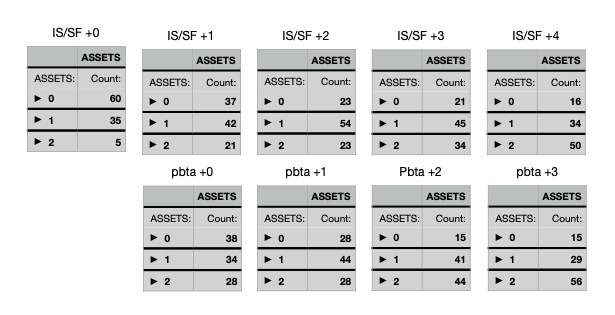
If you look just at the number of Misses, i.e. fails, they’re pretty consistent.
I think I was seduced by “complex = superior”, especially coming from such a polyhedral background. TBH, I’m not sure I’m comfortable with rolling just 2d6. WTF do I do with all my other dice???